
“The first bus built in the workshops of the collectivized General Autobus Company” I assume the year is 1936 and refers to the Compañía General de Autobuses based in Barcelona. From here
“The first bus built in the workshops of the collectivized General Autobus Company” I assume the year is 1936 and refers to the Compañía General de Autobuses based in Barcelona. From here
Documentary about the Francoist repression and the mass graves in Spain. (in Spanish)

Plaque to the victims of the March 1938 bombings of Barcelona. Carrer del Carme, Raval. Dozens of people were killed in the street.

An odd one. “Unidad”, the newspaper of the fascist Falange printed in San Sebestián from 6th May 1937 claiming that anarchists had killed Lluis Companys during the Barcelona May Days and asks “has [CNT leader] Garcia Oliver also fallen’?
Clearly wishful thinking, though Companys was later executed/murdered by the Franco regime in 1940.
Thanks to Hessel Schaaf for sending me this. Source here
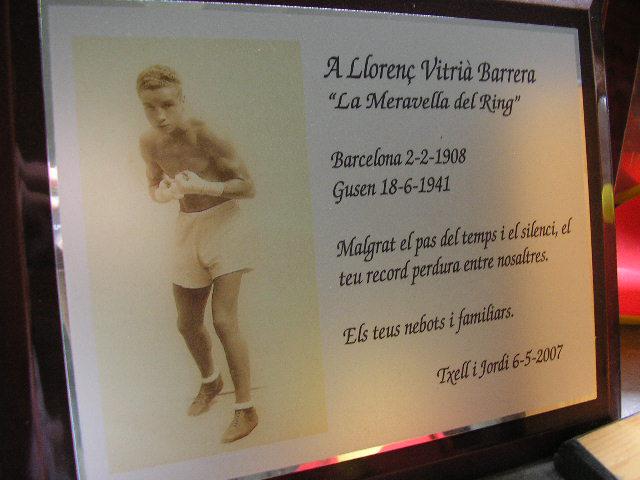
A belated Holocaust Memorial Day remembrance.
Llorenç Vitria, from Barcelona and flyweight Olympic champion in Paris 1924, managed to cross into France in 1939 where he was later captured by the Nazis, and sent to the hell of Gusen, a sub-camp of Mauthausen, Austria. Here he was registered as prisoner number 4,074 and given a unifom with an “S” denoting “Spanien”. The SS used to entertain themselves in the camp organising boxing fights between the prisoners. Without hope and tired of all the horror, on 18 June 1941 he committed suicide by throwing himself against an electrified fence . The plaque can be seen today in Mauthausen. More here in Catalan

A shooting gallery in Plaça de la Universitat, Barcelona. 1936 named “Pim Pam Pum Antifeixista” (Anti-fascist bang-bang) in which participants got to shoot the insurgent generals. Profits went to the militias, including 97 pesetas on 13 October 1936 as you read here in La Vanguardia published the day after.

Industrial memory in Barceloneta. Entrance to the great Maquinista factory, once the largest complex in Spain

Francesc Català-Roca, Fiesta with the Chunga family, Montjüic, Barcelona 1955, with the Canadenca chimneys of the Paral.lel as a backdrop.
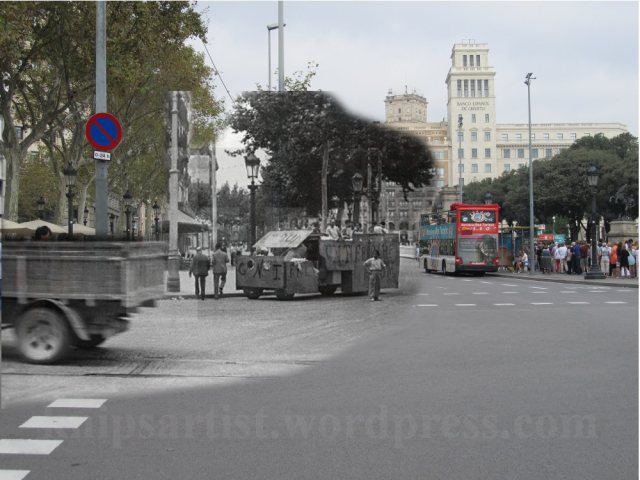
Remarkable retrophotograph by Ulrich Eumann, an expert in the work of Hans Gutmann, better known in Spanish as Juan Guzmán. It shows several tiznaos (the name for vehicles armoured with steel plates) in Plaça Catalunya on 20 July 1936 combined with the square today complete with a Bus Turístic. It is amazing that within one of day of the coup the anarchist workers set to welding these plates on trucks and luxury Hispano-Suizos. More here in German

Child in Barcelona 1938 by Ione Robinson.
“In September 1938, Robinson arrived in Barcelona. Over the course of two months, Robinson produced a series of drawings and paintingsin the Catalan munitions factories, refugios, hospitals; and on the Ebro front with the Republican 5th Army . As she writes in her 1946 memoir, A Wall to Paint On, “…in the drawings I have made here in Spain I have tried to express-through simple line-the agonizing effect of war upon the innocent victims: the women and children…through what I felt and saw in their eyes-and hands.” She left Spain at the end of October, 1938.” More here http://ionerobinson.org/