Madrid.
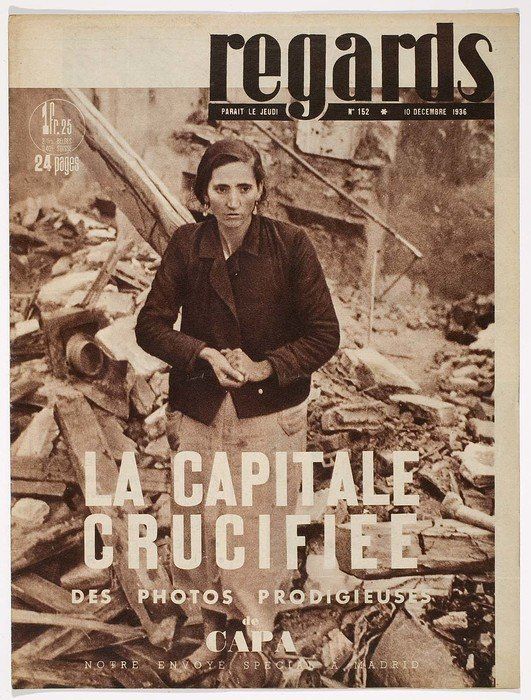
10 December 1936. Front cover of French magazine Regards.
Robert Capa
Madrid.
10 December 1936. Front cover of French magazine Regards.
Robert Capa
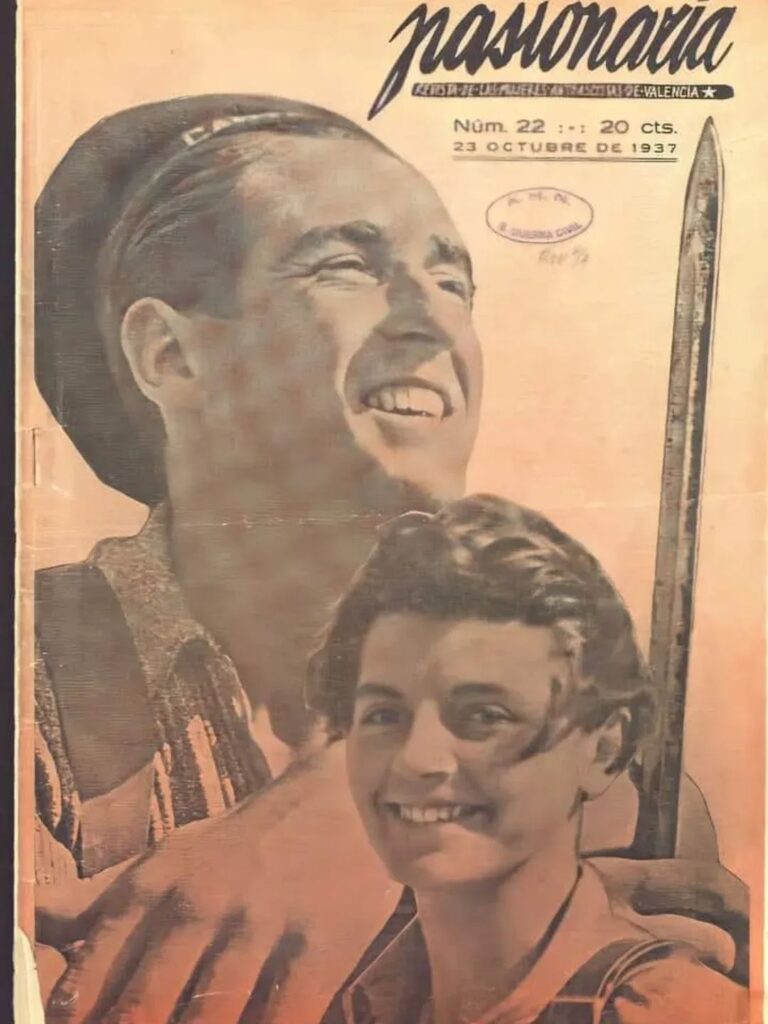
I believe this is the only known use of Juan Guzman’s famed Marina Ginestà photo shot during the Spanish Civil War itself, an image which has come this century to represent more than any other the revolutionary hopes of 1936. That said, it is a different shot in the reel from the famed image
CP women’s magazine Pasionaria, 23 October 1937.

Barcelona 1938 David Seymour. I’m not sure if that is the Boqueria market or Barceloneta market. If the latter it would make it 18 September 1938 on which more than 40 people were killed. Sant Antoni market was also hit. Original here at Magnum.

A colourised version of the famous and iconic Marina Ginestà photo standing on the roof of the Hotel Colón in Plaça Catalunya on 21 July 1936. In fact she was never a militia fighter. She worked through the war as a journalist and as an interpreter for the Soviet correspondent Mijaíl Koltsov. This colourised version of Hans Gutmann (Juan Guzman)’s original is by Jared Enos. Great job and gives impression of photo a little overexposed due to the sunlight which adds authenticity
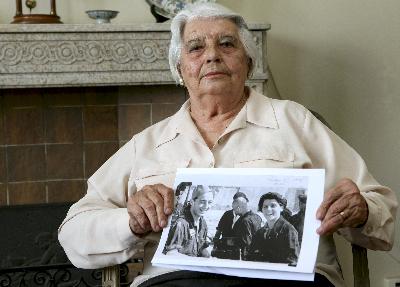
Sad to announce that Marina Ginestà, the woman in the iconic photograph by Hans Guttman of the Colón Hotel in July 1936, died last week in Paris aged 94. I would have loved to have met her. La Vanguardia.com

Striking photomural by Josep Renau, exhibited at the Spanish Pavilion of the 1937 Paris World’s Fair (as was Guernica), contrasting a woman from Salamanca in bridal dress and a militiawoman from Barcelona – in trousers as she strides confidently forward.. The legend on the glass under the militiawoman confirms this message: “The New Woman of Spain has rid herself of the superstitions and misery of her past enslavement and is reborn and capable of taking part in the celebration of the future”
“Superimposed on a glass wall, and standing side by side, are life-sized photos of two Spanish women. One woman is dressed in a traditional, elaborately constructed, and richly decorated wedding dress. The other woman, a Republican militiawoman, is wearing an open-collared shirt and trousers. The woman wearing the traditional dress appears weighted down by its voluminous multi-layered skirt and long sleeves. Her arms hang down limply by her side, her mouth is tightly closed, and she stares straight ahead. In comparison, the fabric of the trousers and shirt of the militiawoman is lightweight enough to appear to be moving as she strides confidently forward. Her arms convey strength and movement, as does her left shoulder, which seems to more toward the viewer. The woman’s mouth is open and she appears to be issuing some sort of command. Her eyes are piercing and intent. Her head is uncovered and her hair is pulled off her face. Unlike the bride in the other photograph, this woman appears to be walking out of the display straight towards the visitor. The only adornment on her clothing is a leather strap across her shoulder–possibly a gun holster–investing her with an aggressive and militaristic persona. ”
Explaining the intended message of Renau’s photomural,Jordana Mendelson writes:
…Renau contrasted the Arxiu Mas image of traditional culture with the forward stride of a young militia woman. The photomural
used the visual comparison to reinforce a message about the liberation of women under the Republic: shedding her age-old
traditional dress, the new woman of the revolution would find freedom in her fight against fascism.The legend on the glass under the militiawoman confirms this message: “The New Woman of Spain has rid herself of the superstitions and misery of her past enslavement and is reborn and capable of taking part in the celebration of the future” (Graham 112 n.7).
For visitors to the 1937 World’s Fair, the trousers on the miliciana would have been the most obvious sign of Spanish women’s new emancipation and alignment with aggressive political action. As Nash explains … for [Spanish] women the wearing of trousers or monos [blue
overalls] acquired an even deeper significance, as women had never before adopted such masculine attire. So for women, donning the
militia/revolutionary uniform not only meant an exterior identification with the process of social change but also a
challenge to traditional female attire and appearance.


Classic photo by Augustí Centelles of the POUM militia at the Lenin barracks in Barcelona probably in early January 1937. Note a certain tall Englishman at the back.

Francesc Català-Roca, Fiesta with the Chunga family, Montjüic, Barcelona 1955, with the Canadenca chimneys of the Paral.lel as a backdrop.
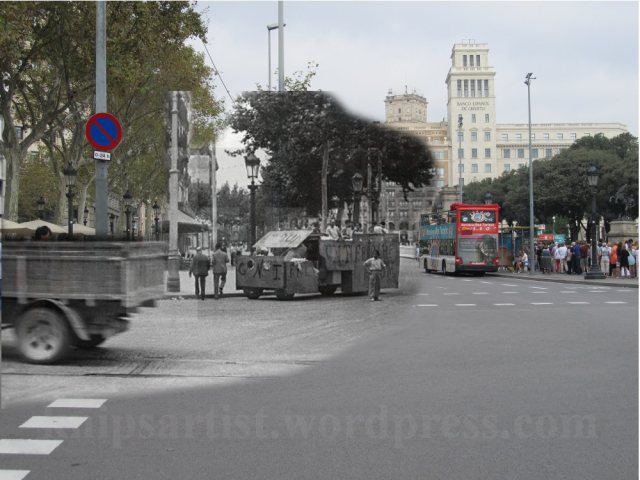
Remarkable retrophotograph by Ulrich Eumann, an expert in the work of Hans Gutmann, better known in Spanish as Juan Guzmán. It shows several tiznaos (the name for vehicles armoured with steel plates) in Plaça Catalunya on 20 July 1936 combined with the square today complete with a Bus Turístic. It is amazing that within one of day of the coup the anarchist workers set to welding these plates on trucks and luxury Hispano-Suizos. More here in German